Gold Header Ad
reserve your ad hereCannabis is a very versatile plant that can adapt to a wide range of growing styles. Indoor cannabis cultivation can be approached in many ways. Still, one of the most effective, yet more advanced methods is the SCROG technique, short for Screen of Green.
Growers familiar with the Sea of Green (SOG) method will recognize SCROG as a more hands-on approach, focused on maximizing yield from fewer plants through careful training and extended vegetative growth.
This guide explains how SCROG works, the training methods involved, its advantages and challenges, and how to choose the right strains, and my top tips to help you become a master of training your plants using the SCROG method and smashing yields out of the park!
What Does SCROG Mean?
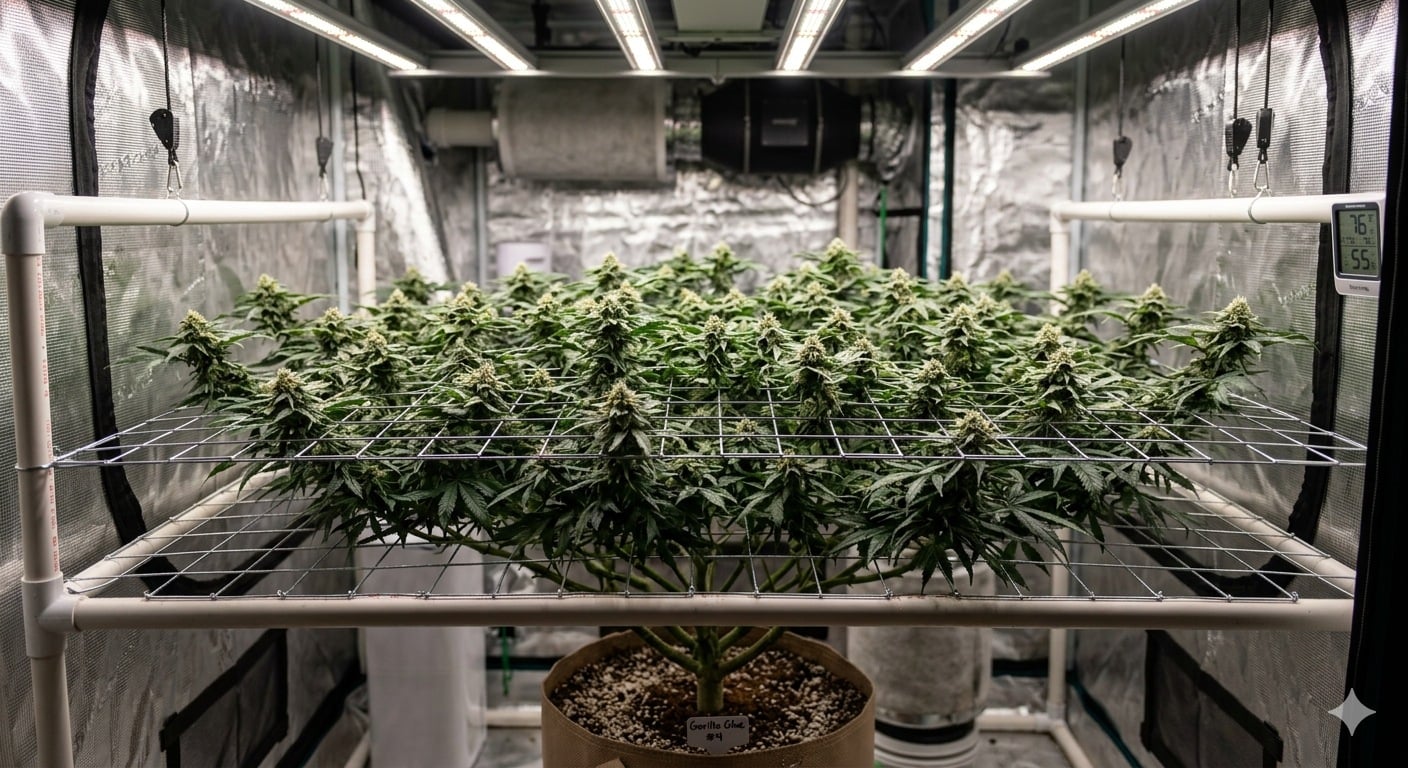
SCROG (Screen of Green) is a plant-training technique that encourages cannabis plants to grow horizontally along a screen or mesh. The goal is to create a flat, even canopy where all bud sites receive equal light exposure.
A screen, such as a net, trellis, bamboo frame, or wire grid, is positioned above the plants. As the plants grow during the vegetative stage, branches are gently guided through the screen using low-stress training (LST). This spreads growth evenly across the canopy and ensures that all growth shoots receive equal light and penetration.
At the same time, all growth beneath the screen is removed. This directs the plant’s energy toward the upper canopy, resulting in larger, denser top colas and more efficient use of light. This style of growing is certainly the most demanding in terms of time spent on vegetation, plant training, and hands-on maintenance.
Why Is The Cannabis SCROG Method Worth Trying?
One of the main reasons growers switch to the SCROG technique is the potential for massive yields. There are also other reasons, as explained below.
Perfect for low plant counts: Growers who prefer to grow one or two large crops will find the SCROG method advantageous.
Plants produce uniform primary and secondary colas: A well-trained cannabis SCROG will produce baseball bat-size buds through every space in the screen.
Higher yields from fewer plants: A well-trained SCROG setup using just 1–2 plants can produce yields comparable to a Sea of Green grow with 9–12 plants.
Improved light distribution: An even canopy ensures all bud sites receive consistent light, enhancing both quality and density.
Better plant control: SCROG encourages growers to develop a deeper understanding of plant structure and training techniques.
Training Techniques Required for SCROG
If you are ready for the challenge of a SCROG set up, then you must be prepared to get hands-on with your plants and train them over an 8-12 week period. Below are some of the different plant training techniques you may wish to incorporate into the training schedule.
Topping
Cutting the main stem forces the plant to develop multiple primary colas instead of a single dominant one. Repeating this process creates a bushier plant with more flowering sites.
Pruning and Defoliation
All growth below the screen should be removed to focus energy on the upper canopy. This can be done gradually or in a single session during the vegetative stage, depending on the grower’s preference. Pruning and defoliation are an essential part of the training stage.
Super Cropping
A more advanced, high-stress technique where branches are bent until the inner tissue softens. The plant responds by strengthening the damaged area, improving nutrient flow and structural support.
Low-Stress Training (LST)
Branches are gently bent and guided through the screen to maintain an even canopy. This improves light exposure and encourages uniform growth.
Choosing the Right Strains for SCROG
Not every cannabis strain is ideal for SCROG. Sativa-dominant hybrids are typically the best choice due to their natural height, stretch, and branching characteristics.
Strains with wider internodal spacing allow easier training and better canopy development. While indica-dominant plants can still be used, they generally require more effort to manage due to their compact growth and limited stretch.
Mistakes to Avoid for SCROG Growers
A Screen of Green grow can take months of hard work to get right and produce those epic yields that we all dream of. Below are some of the most common mistakes to avoid.
Allow for a Long Vegetative Stage

SCROG requires patience. Expect to keep plants in the vegetative phase for 8–12 weeks, applying regular training to shape the canopy. Flowering time may also take between 9 and 10 weeks due to the massive yields that can be achieved.
The screen is too low.
Positioning the screen too low or too high above the canopy can affect the shape and structure of the canopy. Keep the screen around 60cm above the top of the pots and let the plant grow upwards and be guided through the net.
Use the Right Net Size
Using a net screen where the space between the net is too small for plants to comfortably fit through. A mesh size of around 3 inches (7–8 cm) is ideal. This spacing allows branches to pass through easily without causing damage.
Not Giving Plants Time to Recover
After applying stress techniques like topping or super cropping, allow at least 4–5 days for recovery. Healthy, strong plants respond better to continued training. You will be required to be hands-on with your plants for a long time, so give them plenty of time to recover between plant training sessions.
Select Suitable Genetics
Stick with strains that naturally stretch and branch well. Sativa-dominant hybrids are typically the most forgiving and productive in SCROG setups. Avoid indica-dominant or autoflowering cannabis plants, as they tend to stay low and produce short internode spacing.
Poor Airflow
A dense SCROG canopy can restrict air movement. Use at least two oscillating fans at different heights to maintain consistent airflow and reduce the risk of mold during flowering. If you begin flowering and the air flow is poor, you can run into a serious mold or mildew issue.
Feature photo: A perfect example of how one large plant can be grown using the SCROG method.
Gold Scrolling Footer Ad
reserve your ad here