Gold Header Ad
reserve your ad hereGrowing cannabis indoors requires careful attention to lighting, nutrition, environmental conditions, and plant structure. If you have ever wondered why I am getting such a small yield after harvesting?, then this article will help you greatly. I will explain different methods to help improve your yields and get more bang for your buck!
Does Pot Size Help Improve Yields?
The size and type of growing container influence root development, watering requirements, and overall plant structure. Larger containers provide more growing medium and greater room for roots to develop, while smaller containers are easier to move and generally require less growing medium.
Fabric pots are commonly used because their porous sides allow air to reach the root zone and encourage natural root pruning. Traditional plastic containers can also work well when they provide adequate drainage.
Whatever container is selected, drainage is essential. Excess water around the roots can reduce oxygen availability and create conditions that encourage root problems. The container should therefore allow excess water to drain freely rather than remaining saturated. Autoflower seeds should be planted in a large sized pot and not repotted to avoid stunted growth.
Controlling Your Grow Room Environment
Temperature, humidity, and airflow all contribute to plant health. Indoor growing areas can change rapidly, particularly when powerful lighting and electrical equipment are operating for extended periods.
A digital thermometer and hygrometer provide an easy way to monitor environmental conditions. Keeping records can also help identify patterns, such as excessive humidity during the dark period or temperatures becoming too high when lights are operating.
Air movement is equally important. Oscillating fans can prevent stagnant pockets of air from forming around the foliage while helping maintain a more consistent environment throughout the growing area.
Adequate ventilation also helps replace stale air and control heat and humidity. During flowering, paying particular attention to humidity and airflow is important because dense plant growth can create areas where moisture remains trapped.
Properly Managing Nutrition and Watering
Plant nutrition is another fundamental part of indoor cultivation. Cannabis requires a combination of macronutrients and micronutrients throughout its lifecycle, including nitrogen, phosphorus, potassium, calcium, magnesium, sulphur, iron, zinc, and several other trace elements.
Use nutrient products according to the manufacturer’s instructions. Applying more fertilizer than recommended does not necessarily result in healthier plants and can instead cause nutrient stress.
Watering should also be based on the condition of the growing medium rather than following an inflexible schedule. Containers that remain excessively wet for long periods can create problems with oxygen availability around the roots.
Observing the plants is one of the best ways to identify potential issues. Wilting, unusual leaf colouring, burnt leaf tips, and sudden changes in growth can all indicate that something in the growing environment needs attention.
Have You Tried SOG and SCROG Growing Styles?
Two well-known approaches to organising indoor plants are Sea of Green (SOG) and Screen of Green (SCROG).SOG involves growing multiple smaller plants close together to create a relatively uniform canopy. The approach focuses on filling the available growing area efficiently while keeping individual plants relatively compact.
SCROG takes the opposite approach, using training and a screen or trellis to spread fewer plants horizontally. Branches are positioned across the screen to create a more even canopy.
Both methods require planning and regular maintenance. The better approach depends on factors such as available space, plant numbers, equipment, cultivation experience, and local regulations.
The Importance of Correct pH Ranges
pH management is particularly important because it affects nutrient availability. Plants can only absorb nutrients effectively within an appropriate range, and significant deviations can interfere with nutrient uptake.
A plant may therefore display symptoms resembling a nutrient deficiency even when plenty of nutrients are present in the growing medium. This can happen because an unsuitable pH prevents the roots from accessing those nutrients effectively.
The appropriate pH range depends partly on the growing medium and cultivation system. Soil, coco coir, and hydroponic systems each have different requirements, so growers should follow recommendations appropriate to their particular setup.
Regularly checking irrigation water and nutrient solutions can help identify problems before they become severe.
Growing With Optimal Light Intensity and PPFD

Lighting is one of the most important elements of an indoor growing environment. Plants use photosynthetically active radiation (PAR) for photosynthesis, meaning that the quality and intensity of usable light are more important than simply how bright a fixture appears to the human eye.
PPFD, or Photosynthetic Photon Flux Density, measures the amount of usable light reaching a particular area of the plant canopy. It is expressed in micromoles per square metre per second (µmol/m²/s) and is one of the most useful measurements when evaluating indoor lighting.
The distance between the light fixture and the plants is also important. Grow lights should be installed according to the manufacturer’s recommendations, with adjustments made as plants grow. Excessive light intensity can cause stress, bleaching, or leaf damage, while insufficient light can lead to weak, elongated growth.
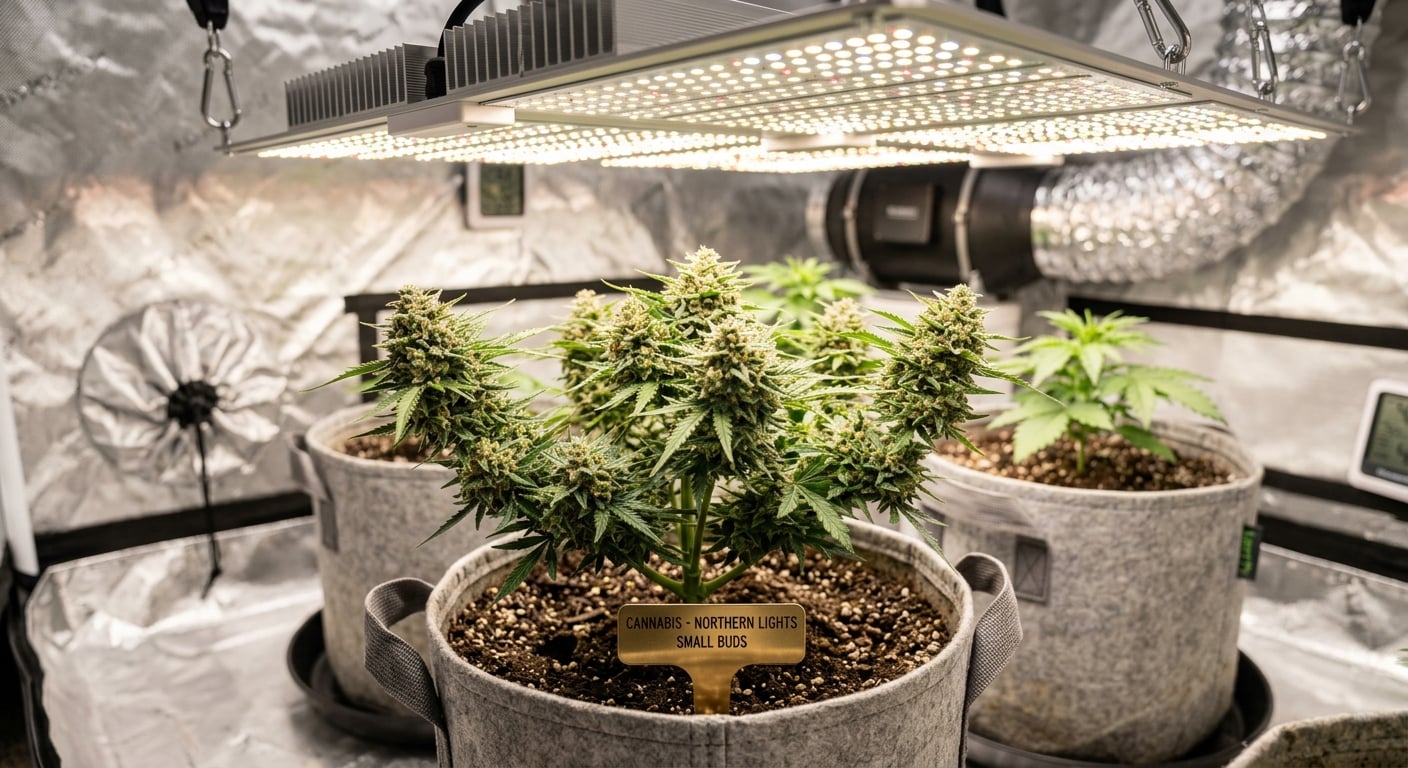
Modern LED fixtures have become particularly popular for indoor cultivation because they can provide strong, efficient illumination while producing less radiant heat than some traditional lighting systems.
Plant Training for The Win!
Cannabis plant training involves altering the structure of a plant to control its shape and improve the distribution of foliage. Indoor growers commonly discuss several techniques.
Topping involves removing the growing tip to encourage the plant to develop multiple main branches. This can create a bushier structure rather than allowing a single central stem to dominate.
Low-stress training (LST) uses gentle bending and positioning rather than removing large amounts of plant material. Branches can be encouraged to grow more horizontally, creating a broader and more evenly distributed canopy.
Fimming is another method of modifying the growing tip. Instead of removing the entire tip, only part of the new growth is removed, which can encourage the development of multiple shoots.
Super cropping is a more aggressive technique involving controlled damage to stems. Because it can stress or injure plants when performed incorrectly, it requires considerably more care than gentle training methods.
Pruning, sometimes referred to as lollipopping, involves removing selected lower growth or foliage. The goal is generally to manage plant structure and improve airflow rather than simply removing as much foliage as possible.
Regardless of the technique, excessive training or pruning can stress a plant. Healthy plants should be given sufficient time to recover from significant structural changes.