Gold Header Ad
reserve your ad hereIf you grow plants indoors using high-intensity lighting such as metal halide (MH), high-pressure sodium (HPS), or LED fixtures, you may notice that the light appears white, warm, or slightly cool to the eye.
What we cannot see with the naked eye is the combination of wavelengths that makes up that visible light. Each wavelength can influence plant growth, development, photosynthesis, flowering, and plant structure in different ways. Understanding the light spectrum can therefore help indoor growers make more informed decisions when choosing and using horticultural lighting.
In this article, I will break down and cover all you need to know about growing different light spectrums, explain the differences between blue and red, how cannabis plants respond to the spectrum and what to consider when choosing the best indoor grow light for cannabis cultivation.
Choosing the Right Spectrum for Growth and Development
There is no single wavelength that makes a grow light “best” for every plant or every stage of growth. Plant performance depends on the interaction between spectrum, light intensity, photoperiod, temperature, carbon dioxide availability, nutrition, and the plant’s genetics.
For most indoor growing applications, a high-quality full-spectrum LED can provide an effective balance of wavelengths throughout the entire crop cycle. Understanding how plants respond to different wavelengths allows growers to look beyond the color of the light and consider what is actually happening within the spectrum.
The goal is not simply to produce light that looks good to the human eye. The goal is to provide plants with an appropriate combination of wavelengths and light intensity that supports healthy growth, efficient photosynthesis, and successful flowering
The Cannabis Light Spectrum Explained
Light is measured in nanometers (nm), with different wavelengths producing different effects in plants. The main portions of the spectrum relevant to horticulture are covered below:
- Ultraviolet (UV): approximately 200–400 nm
- Blue light: approximately 400–500 nm
- Green light: approximately 500–600 nm
- Red light: approximately 600–700 nm
- Far-red light: approximately 700–800 nm
Blue and red wavelengths are particularly important for photosynthesis, while far-red light plays an important role in plant signaling, development, and responses to the surrounding light environment. If you are growing from seed or clone, photoperiods or using autoflowering seeds, plants will respond the same way to different wavelengths of light.
Red Light: 600–700 nm
Red light is strongly absorbed by chlorophyll and is highly effective at driving photosynthesis. It also interacts with plant signaling systems that influence growth, flowering, and plant architecture.
Red light is particularly useful during the flowering stage, but that does not mean it should be used on its own. A balanced spectrum containing both blue and red wavelengths can support healthy photosynthesis while helping maintain appropriate leaf development and plant structure. The relationship between red and blue light is therefore more important than simply maximizing one wavelength.
Far-Red Light: 700–800 nm
Far-red light sits immediately beyond the visible red portion of the spectrum and is closely associated with the way plants sense their surroundings. Far-red wavelengths can influence plant architecture, stem elongation, leaf positioning, flowering responses, and the plant’s perception of whether it is growing in full light or shade. Far-red light is also important because plants use it in combination with red light to regulate developmental processes.
How Do Plants Detect Red and Far-Red Light?
Chlorophyll is responsible for capturing much of the light used in photosynthesis, but plants also have specialized light receptors called phytochromes. Phytochromes allow plants to detect changes in the balance between red and far-red light. This gives the plant information about its environment and helps regulate a range of biological processes.
Red Light and Phytochrome Activation and Regulation
When plants absorb red light, phytochromes shift into a biologically active state. This can influence processes such as seed germination, flowering, stem development, and other growth responses. Far-red light shifts phytochromes in the opposite direction. The balance between red and far-red wavelengths therefore acts as an important signaling system.
This is particularly relevant to shade avoidance, where plants may respond to a reduced red-to-far-red ratio by producing longer stems and changing their growth pattern. Phytochromes also interact with the plant’s internal biological clock, helping coordinate growth and development with the day-night cycle.
So, How Do Indoor Cannabis Plants Respond to Red Light?
For indoor growing, a well-designed full-spectrum fixture generally provides a more useful lighting environment than relying on isolated wavelengths.
- Contribute strongly to photosynthetic activity
- Be efficiently absorbed by chlorophyll
- Influence flowering and reproductive development
- Interact with plant hormones and signaling pathways
- Affect plant architecture and morphology
- Influence internodal spacing and stem development
- Work together with far-red light to regulate developmental responses
Blue light is also important, particularly for maintaining compact growth, healthy leaves, and normal plant development. Rather than thinking of red, blue, and far-red light as completely separate systems, it is more useful to understand them as interacting components of the plant’s overall light environment.
Which Grow Light Is Best for Flowering Plants Indoors and Why?
Once you understand how different wavelengths influence plant development, the next question is which type of grow light is best for indoor flowering plants. The three most common technologies are metal halide, high-pressure sodium, and LED. Each produces a different spectral profile and has different advantages.
#1 – Metal Halide (MH)
Metal halide is a type of high-intensity discharge (HID) lighting that produces a relatively broad, blue-rich spectrum compared with HPS. MH fixtures have traditionally been popular during the vegetative stage because their spectrum can support compact, leafy growth. However, modern horticultural LEDs can provide a much more precisely engineered spectrum, making them a popular alternative to traditional HID systems.
#2 – High-Pressure Sodium (HPS)
High-pressure sodium lighting has been used extensively in indoor horticulture for many years. HPS lamps produce a spectrum that is particularly strong in yellow, orange, and red wavelengths. This makes them well suited to supporting flowering and fruit production, although the exact spectrum varies between lamps and manufacturers.
HPS fixtures can produce excellent results, but they also generate considerable heat and generally consume more energy than modern, efficient LED systems for a comparable amount of usable plant light.
#3 – LED Grow Lights
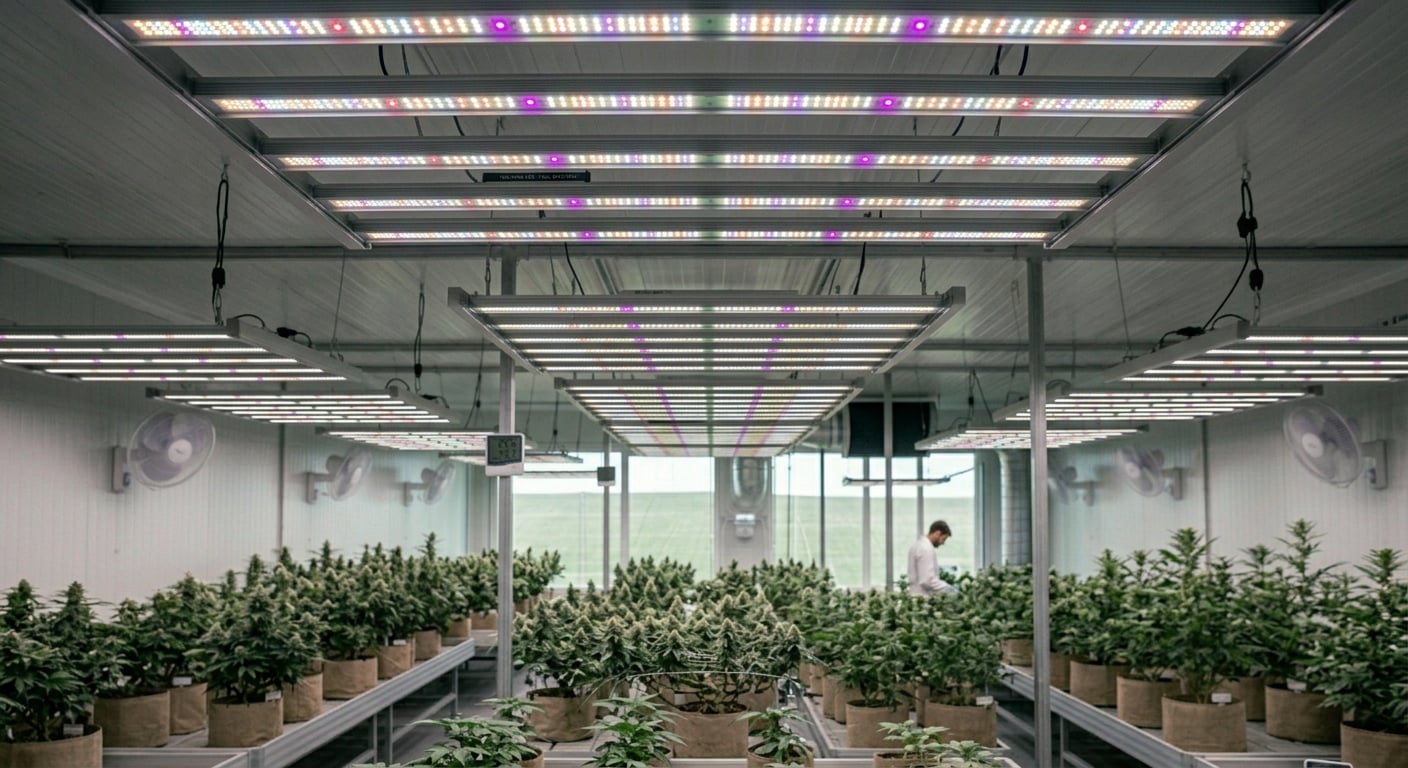
LED technology has changed indoor horticultural lighting significantly and are the most popular choice for indoor cannabis grow lights. Unlike traditional HID lamps, LEDs can be manufactured using different diode types and wavelengths, allowing manufacturers to create fixtures with specific spectral characteristics.
Modern horticultural LEDs commonly cover much of the photosynthetically useful portion of the spectrum, often including blue, green, red, and sometimes far-red wavelengths. The exact spectrum depends on the fixture and manufacturer, but LEDs offer growers the ability to combine energy efficiency, adjustable spectrum, and high light output in a single system.
Gold Scrolling Footer Ad
reserve your ad here